Building Information Modeling

BIM · ISO 19650

Connected information from strategy to renewal. We deliver information-rich models within a controlled common data environment — one single source of truth for every stakeholder.

Home  /  BIM
Our core discipline

One controlled model, from brief to handover.

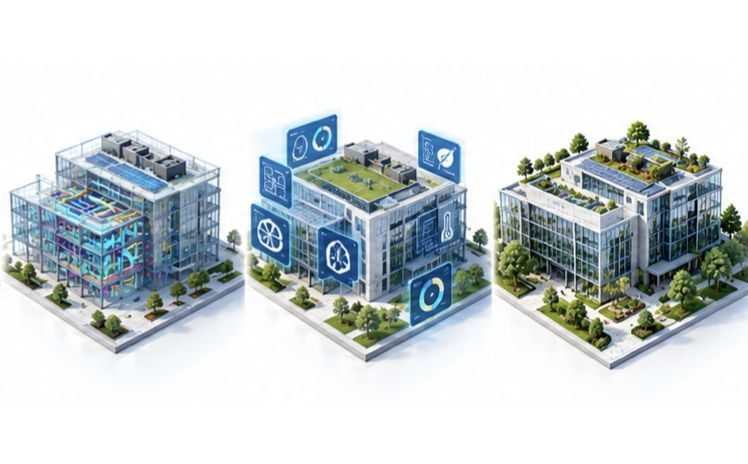
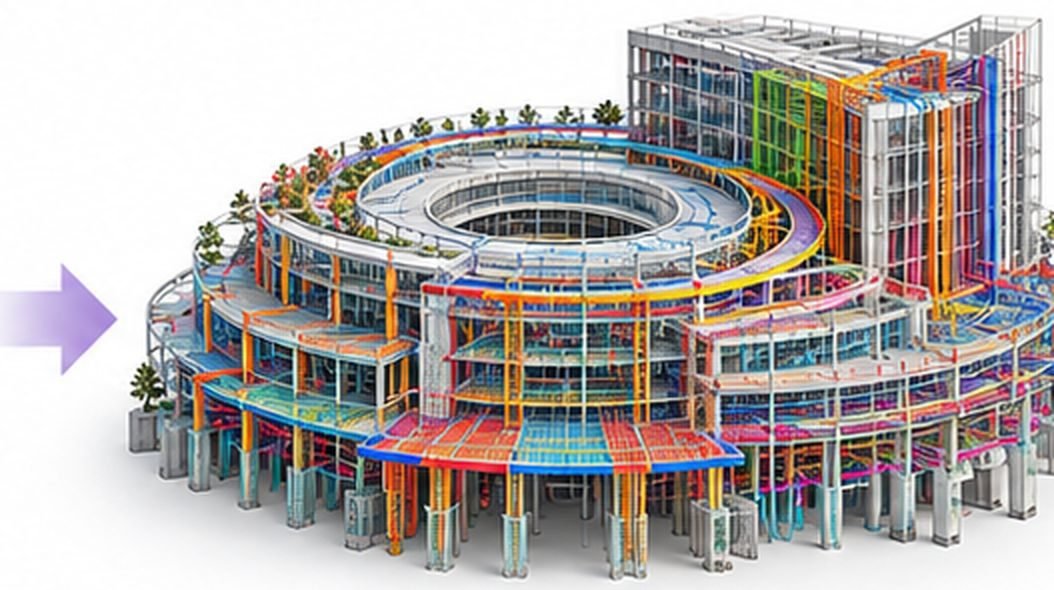
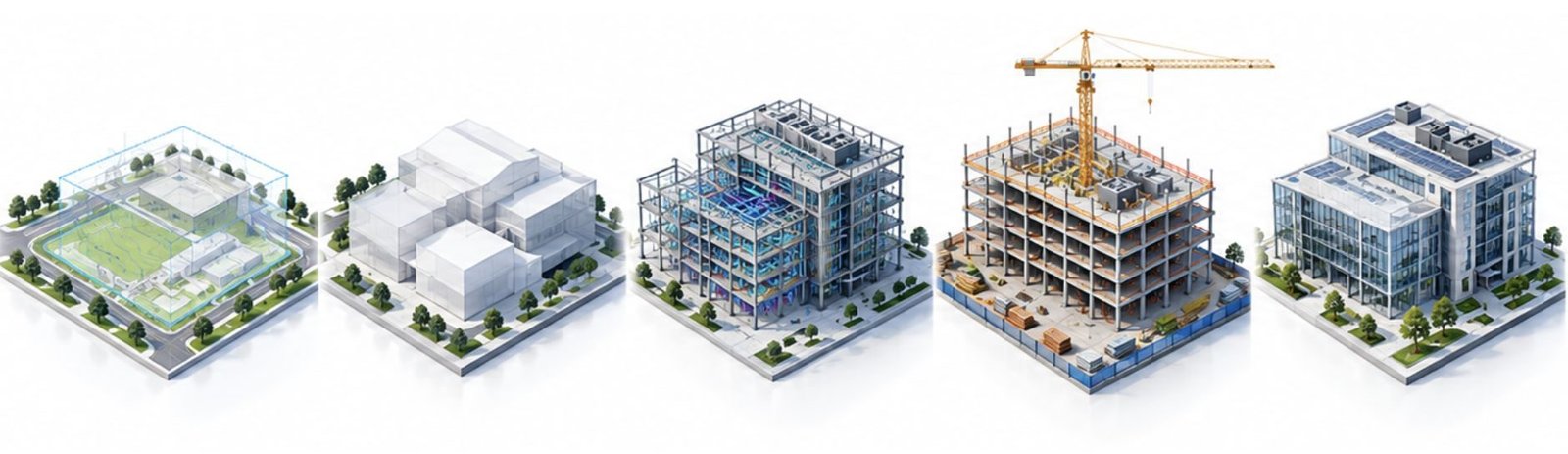
BIM is at the centre of everything we deliver. One information model, managed to ISO 19650, connects every stakeholder from the first brief to as-built handover and becomes the foundation of the digital twin.

10%of contract value saved through clash detection, at best
40%fewer un-budgeted changes, at best
Work with us
Why BIM

One model, every decision

BIM aligns design, cost, time and asset data in a single coordinated source, so conflicts are found in the model instead of on site. Documented project outcomes show what that can deliver.

Clash detection10%

of contract value saved, at best

Change control40%

fewer un-budgeted changes

Estimating3%

cost-estimate accuracy

Speed80%

less time to produce estimates

Programme7%

shorter project duration

Reported maxima from published case studies, not guaranteed savings. Source: Stanford CIFE TR171.

Global BIM adoption

Required by governments worldwide

MarketPublic-sector requirement
United KingdomLevel 2 BIM required for centrally procured public projects from 2016.
SingaporeMandatory BIM e-submission phased from 2013; new projects over 5,000 m² by 2015.
FinlandSenate Properties required IFC-based BIM from 2007; COBIM followed in 2012.
Dubai, UAEDubai Municipality introduced BIM requirements in 2013 and expanded them in 2015.
IndiaThe 2023–24 Economic Survey called for BIM to reduce delays, cost and inefficiency.
IrelandPublic works BIM adoption began in January 2024 under a phased national timeline.

Sources: UK Government; Singapore BCA; buildingSMART Finland; Dubai Municipality; Government of India Economic Survey; Ireland CWMF.

PIM stages
Project information model / PIM

Build right

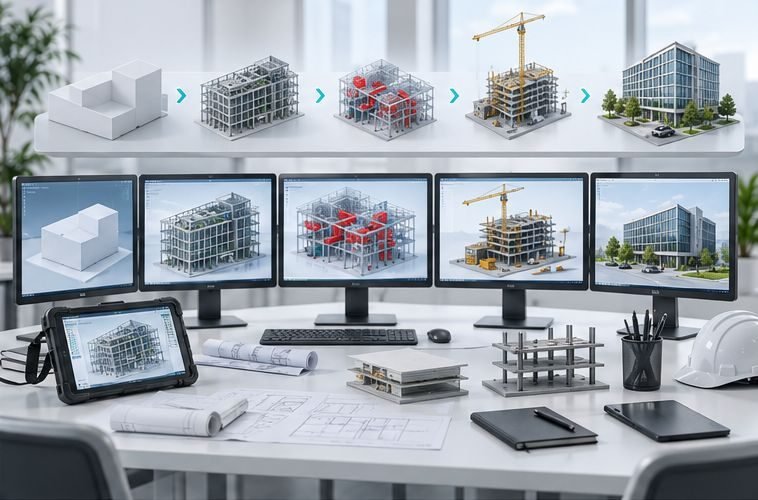
Eight stakeholders — client, architects, engineers, contractor, consultant, regulator, FM team and end users — working from business need and vision to as-built verification.

01

Brief

Project goals, site analysis, stakeholder needs, regulatory context, success criteria.

02

Concept

Massing and options, space planning, cost and carbon studies, feasibility, visualisations.

03

Definition

Architectural, structural and MEP models, clash detection, design coordination.

04

Design

4D sequencing, 5D cost planning, site logistics, method statements, shop drawings.

05

Build & commission

As-built model, commissioning data, testing and handover, asset data, compliance records.

AIM stages
Asset information model / AIM

Operate smart

Digital handover of verified information enables data-driven management and long-term performance and resilience.

  • HandoverVerified asset model, digital O&M manuals, warranty information, asset tagging, FM team handover.
  • OperationFacility management, preventive maintenance, IoT monitoring, energy analysis, lifecycle planning.
  • In usePerformance optimisation, sustainability tracking, refurbishment planning, space utilisation, predictive maintenance.
Common data environment (CDE)

Single source of truth

The CDE controls models, documents, issues, approvals and information exchanges from appointment through operation — with version control and secure, role-based access.

01

Documents

Drawings, specifications and reports.

02

Models

Architecture, structure and MEP.

03

Data

Non-graphical information.

04

Workflows

Approvals, RFIs and issues.

05

Communication

Track and resolve.

06

Standards

ISO 19650 and openBIM.

07

Access control

Role-based permission.

08

Audit trail

Complete project history.

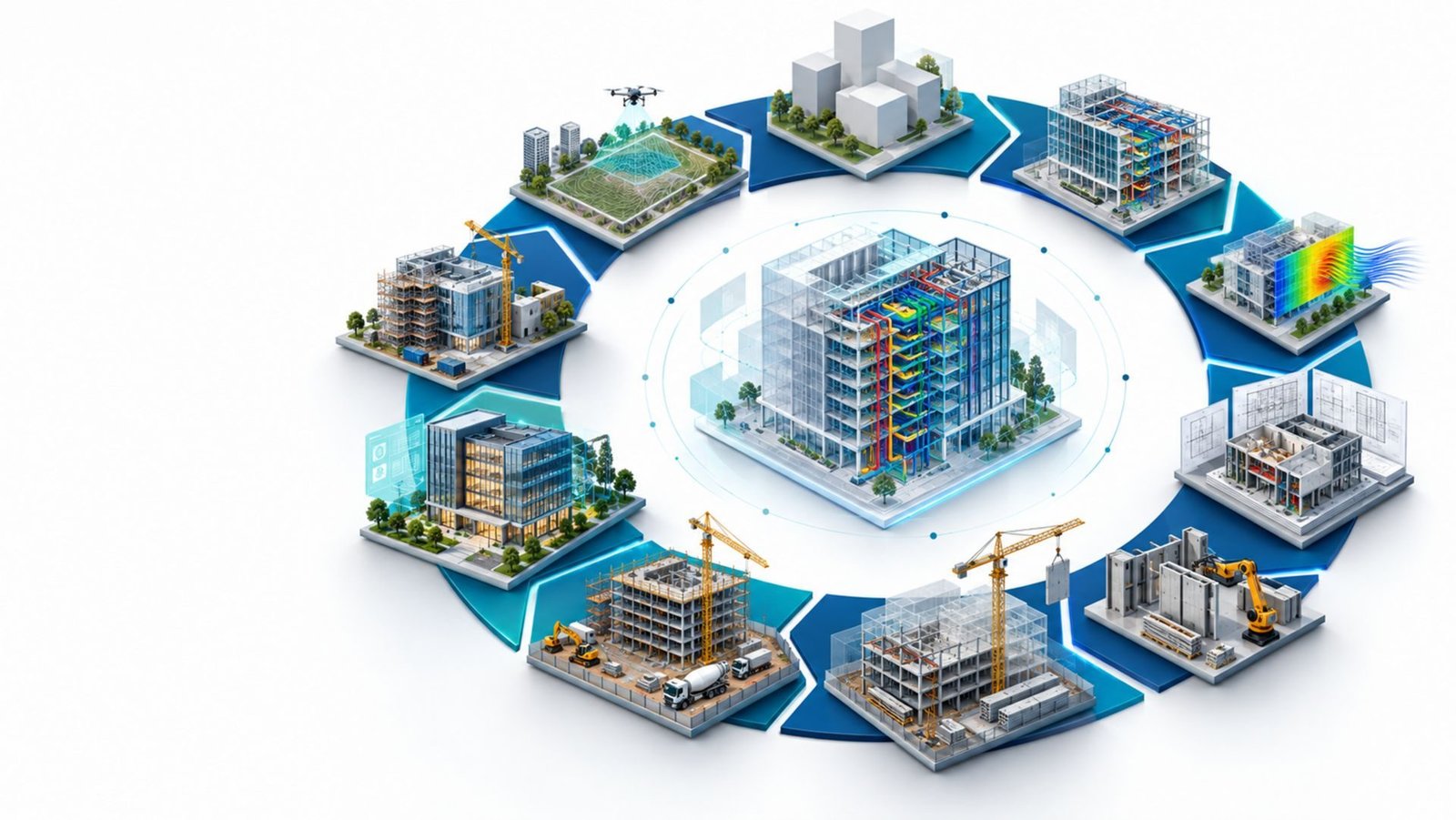
BIM across the asset lifecycle
BIM maturity and levels

From CAD to integrated BIM

The progression from standalone CAD to integrated lifecycle information. Each level adds stronger information management.

  • Level 0Low collaboration — 2D drawings, lines and shapes; no shared CDE.
  • Level 1Partial collaboration — managed 2D / 3D drawings and models.
  • Level 2Full collaboration — federated discipline models shared through a CDE; 4D time and 5D cost.
  • Level 3Full integration — cloud-connected information model; 6D / 7D asset lifecycle management.
Level of development

LOD 100 to 500

LOD states the reliability of a model element at a defined project milestone.

LevelStageDefinition
LOD 100ConceptualSymbol or generic representation. Information derived from it remains approximate.
LOD 200ApproximateGeneric object with approximate quantity, size, shape, location and orientation.
LOD 300Measurable designDesigned quantity, size, shape, location and orientation can be measured.
LOD 350InterfacesLOD 300 plus measurable interfaces with adjacent or dependent elements.
LOD 400FabricationDetail supports fabrication, assembly and installation.
LOD 500Existing / as-constructedObservation, field verification or interpolation establishes the condition. State the accuracy.
Software across BIM delivery

A tested toolchain

One project does not require every product. The team selects a tested toolchain that meets the information requirements; the BEP defines approved applications, versions, file formats, coordinates and exchange tests.

StageScopeTypical software
Requirements & planningOIR, AIR, PIR, EIR, BEP, TIDP and MIDPWord · Excel · Power BI · selected CDE
Concept & masterplanningOptions, site strategy, infrastructure and parametersAutodesk Forma · InfraWorks · Civil 3D · Rhino · Grasshopper
Authoring & analysisArchitecture, structure, MEP, civil and performanceRevit · Archicad · OpenBuildings · ETABS · IES VE
Federation & validationCoordination, rules, issues, clearances and approvalsNavisworks Manage · Solibri · Revizto · BIMcollab
4D & 5DSequence, logistics, quantities, estimate and forecastSYNCHRO 4D · Primavera P6 · Asta Powerproject · RIB CostX · iTWO
Construction & captureField coordination, quality, progress and existing conditionsForma Build · Dalux · Revizto · ReCap Pro · Cintoo
Handover & operationsIFC, COBie, asset register, AIM and connected operationsAutodesk Tandem · Bentley iTwin · IBM Maximo · Planon · Archibus
ISO 7817-1 · level of information need

The right information, at the right time

Define the purpose, exchange milestone, receiver and acceptance criteria. Specify geometrical information, alphanumerical information and documentation. Align the EIR, responsibility matrix, TIDP, MIDP and BEP. Quality, quantity and granularity must match the intended use.

ISO and openBIM
ISO 19650-1 conceptsISO 19650-2 deliveryISO 19650-3 operationISO 19650-5 security ISO 7817-1 LOINIFC · ISO 16739-1BCF issuesIDS requirementsCOBie handoverIDM · ISO 29481
BIM across the asset life cycle

Strategy to renewal

  • Strategic brief & programming
  • Concept design
  • Detailed multidisciplinary design
  • Analysis & coordination
  • Documentation
  • Digital fabrication
  • 4D construction planning
  • Construction & logistics
  • Handover & digital twin operations
  • Renovation & asset renewal
Why choose us

Why choose Dayavanti Associates?

Cost efficiency

Model-driven quantities support budget control.

Time savings

Issues are resolved in the model, with 4D sequencing tested before site.

Sustainability

Cost and carbon studies inform options from concept stage.

Better decisions

Everyone works from one coordinated source of truth.

Collaboration

Client, design team, contractor, regulator and FM team share one platform.

Asset longevity

Verified asset data supports maintenance and lifecycle planning.

Our vision

Our vision for BIM

We see BIM as more than a model: a connected flow of information from strategy to renewal, covering every stage of the asset life cycle.

Build right with the project information model. Operate smart with the asset information model.

FAQs

Frequently asked questions

What is ISO 19650?

The international standard for managing information across an asset. We work to parts 1, 2, 3 and 5, covering concepts, delivery, operations and a security-minded approach.

What is the difference between PIM and AIM?

The project information model helps teams build right during delivery. The asset information model helps owners operate smart after handover.

What is a common data environment?

It controls models, documents, issues, approvals and information exchanges from appointment through operation, with version control and role-based access.

What level of development do you model to?

LOD 100 to LOD 500. LOD states the reliability of a model element at a defined project milestone.

Which software do you use?

One project does not require every product. The team selects a tested toolchain, and the BEP defines approved applications, versions, file formats and exchange tests.

Are the savings guaranteed?

No. The figures are reported maxima from published case studies, not guaranteed project outcomes.

How can I contact Dayavanti Associates?

Call +91 82099 53897 in India or +44 7769 380894 in the UK, or send an enquiry through our contact page. We work across India, London and the GCC.